

Why Startups Are Moving Beyond Metro Cities — India’s New Opportunity Zones
“Progress doesn’t always follow the skyline of glass buildings — sometimes it whispers through quiet towns, new roads, and untapped markets.”
In the past, when we thought of startups, we imagined them buzzing somewhere in big cities — Mumbai, Delhi, Bengaluru, Hyderabad. The lights, the rush, the hustle.
But a shift is unfolding quietly across India. Today, many new startups are choosing to be outside the glitter — outside the metro.
They are moving to Tier-2 and Tier-3 cities — towns that were once considered too small for big dreams. And there is a reason behind this migration:
A mixture of affordability, opportunity, demand — and a growing new middle class hungry for services.
In this article, we explore why startups are moving beyond metro cities, especially around areas like Delhi–NCR outskirts (near places like Bawana), and how growth of Tier-2 cities is changing the startup landscape in India.
1. Metro Cities Are Saturated — Cost & Competition Are Too High
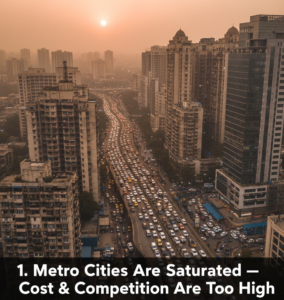
Metro cities have advantages — but also heavy drawbacks for new startups:
-
High rent, expensive office space
-
High salaries for employees
-
Heavy commute, traffic, infrastructure stress
-
Intense competition — many startups, millions of ideas
For a new, small startup or a bootstrapped venture, this means burnout before it even begins.
But move 100–200 km away — to a Tier-2 town or a peri-urban area — and costs fall sharply.
Land, office space, wages, overheads — all become manageable.
This allows startups to focus on product, growth, customers instead of survival costs.
2. Rising Demand in Tier-2 & Tier-3 Cities — Untapped Markets Await

India’s smaller cities are no longer “sleepy towns.”
With growing incomes, digital connectivity, and shifting aspirations, people there want services too — good education, e-commerce delivery, digital payments, entertainment, local transport, health care.
Startups see this as a massive opportunity:
-
Less competition — they can capture market share quickly.
-
Price-sensitive but quality-aware users — good for value-based models.
-
Local advantage — better understanding of ground-level behaviour, less friction, easier outreach.
Hence, startups are building solutions for real needs — and doing well.
3. Better Cost-Efficiency = More Funding for Growth
When a startup spends less on fixed costs (office rent, salaries, utilities), the same funding or revenue goes further.
Savings can be used for:
-
Hiring more staff
-
Product development
-
Marketing & expansion
-
Better salaries
This means a startup in a non-metro city can often grow faster, be more stable, and scale sustainably.
4. Talent Pool Is Expanding — Thanks to Education & Connectivity

Earlier, good talent was seen only in metros — big colleges, elite institutes, etc.
But now:
-
Students from smaller towns are graduating with good education.
-
Many prefer to stay close to home rather than migrate to the city.
-
Remote work culture allows work from anywhere.
-
Cost of living is lower — making salary expectations realistic.
Startups outside metros tap into this emerging, motivated, and affordable talent pool.
5. Lifestyle & Work-Life Balance Become Selling Points

Working in a small town often means less stress — shorter commute, lower noise, lower pollution, more community.
For many young founders and employees, this means:
-
Better mental peace
-
Lower burn-out risk
-
Productivity without constant hustle
This balance attracts more youth to join or build startups in non-metros — and makes them stick longer.
6. Government Push, Infrastructure Growth & Ease of Doing Business
Government policies are slowly favouring growth outside metros:
-
Better roads, highways, rail connectivity
-
Incentives for small-town business development
-
Focus on Digital India, BharatNet, rural electrification
-
Rise in co-working spaces, remote-friendly regulations
This infrastructure growth reduces friction for startups in Tier-2 / Tier-3 cities.
7. Emerging Middle Class & Changing Aspirations Fuel Growth

Tier-2 and 3 cities are seeing rise of a new middle class — more people with disposable income, desire for modern services: quality education, reliable internet, consumer goods, digital solutions, convenience.
Startups that understand these aspirations build products suited to them — and win trust early.
This rising base becomes both users and market drivers, encouraging more ventures to emerge there.
8. Near Delhi NCR – Why Areas Close to Bawana & Suburbs Are Appealing

For those living near Delhi (like Bawana, outer suburbs, NCR periphery), there’s a sweet spot:
-
Access to Delhi’s infrastructure + lower cost
-
Easier logistics (warehousing, supply)
-
Hybrid advantage: proximity to city + reach to hinterland
-
Access to both urban and semi-urban markets
For new-age startups (e-commerce, logistics, ed-tech, small manufacturing, supply-chain), these outskirts provide strategic advantage.
9. Challenges Remain — But Risks Are Lower Compared to Big Cities

Of course, moving beyond metros is not magic.
Challenges may include:
-
Less high-level infrastructure (initially)
-
Sometimes slower internet or logistic connectivity
-
Talent retention issues (some may move to city later)
-
Market education takes time
But for many, benefits outweigh risks — especially in a country where growth and adaptability define success.
10. How Students & Young Professionals Can Use This Shift to Their Advantage

If you’re a student or young professional from a small town / suburb / non-metro area, this trend is a call to attention:
-
Consider joining local startups — less competition, more opportunity
-
If you start a venture, lower cost overhead helps bootstrap without big investment
-
Stay skilled — digital skills, remote-capable skills are in high demand
-
Think regionally — build for semi-urban needs, not just urban class
This shift changes the definition of success — from “migrate to big city” to “grow where you are.”
FAQs — About Startups Moving Beyond Metro Cities
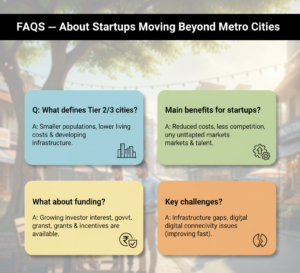
1. Why startups are moving beyond metro cities near Bawana / Delhi NCR?
Because suburbs & outskirts offer lower cost, access to both city and hinterland, cheaper labor & logistics, and less competition — making growth easier.
2. How is the growth of Tier-2 cities affecting startup trends?
Growth of Tier-2 cities brings rising consumption, educated youth, better connectivity, and increasing demand — leading startups to grab the emerging markets there.
3. How is the growth of Tier-2 cities related to the rise of a new middle class?
As income rises, more people demand quality services — education, digital access, education tools, affordable products — which creates demand for startups to serve them.
4. How are cities classified by population / in India (Directorate or Census)?
Cities are classified based on population, infrastructure, and urban development metrics. Tier-1 generally includes metro and major cities; Tier-2 / Tier-3 includes smaller urban towns and suburban areas.
5. How is the growth of Tier-2 cities near Bawana / Delhi helping startups?
Because suburbs combine proximity to metro resources with lower costs and untapped markets — offering niche demand and strategic advantage for startups and young entrepreneurs.
Conclusion

The startup world in India is shifting — quietly, steadily, wisely.
It’s no longer about the glitter of big cities or the prestige of metro offices.
It’s about opportunity, access, affordability, need and growth from ground up.
When startups move beyond metros — they bring with them hope and opportunity for thousands — youth waiting to build, families waiting to rise, towns waiting to grow.
For students and young dreamers: this shift whispers a message —
“You don’t need to migrate to chase your dreams.
Build where you are. Grow where you belong.”